
Short answer: an employer with 50 or more full-time employees, counting full-time equivalents, must offer affordable, minimum value health coverage to at least 95% of its full-time employees and their children, and report those offers to the IRS each year on Forms 1094-C and 1095-C. Miss the offer and the employer can owe a penalty of $3,340 per full-time employee for 2026. Most problems come from counting employees wrong, not from deciding not to comply.
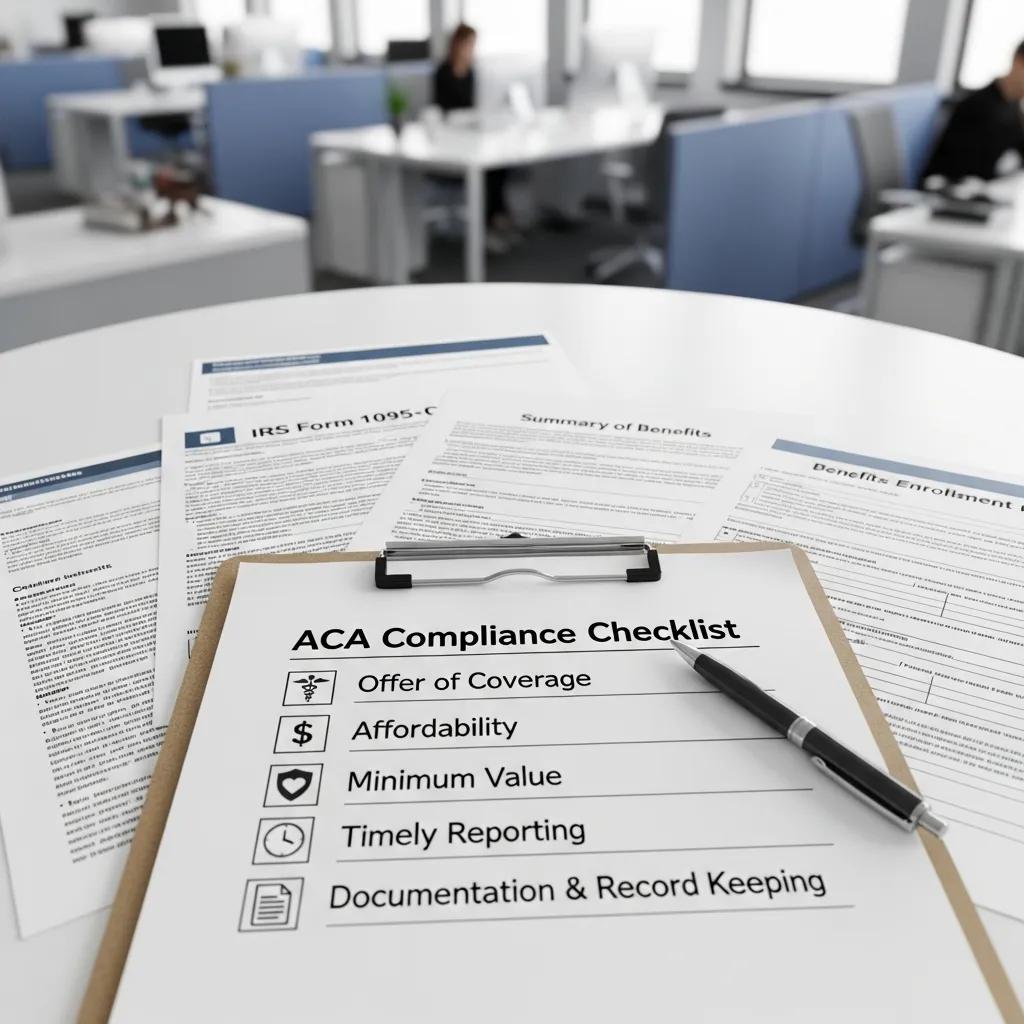
Preventing ACA Employer Penalties: Core Compliance Strategies
- 50 is the line. Full-time employees plus full-time equivalents, averaged over the prior calendar year.
- Affordable means 9.96% for 2026 and 10.22% for 2027, measured on the cheapest self-only option.
- 2026 penalties: $3,340 per full-time employee under 4980H(a) and $5,010 under 4980H(b). For 2027: $3,780 and $5,670.
- Reporting changed. Employers may now furnish Form 1095-C on request, and have 90 days to answer a Letter 226-J.
Step 1: Confirm whether you are an applicable large employer
- Count full-time employees, meaning those averaging 30 or more hours a week (130 hours a month), for each month of the prior calendar year.
- Add full-time equivalents: total the monthly hours of part-time employees (up to 120 per person) and divide by 120.
- Average the monthly totals. 50 or more makes you an applicable large employer (ALE) for the current year.
- Combine companies under common ownership. Related employers in the same controlled group are counted together, even though each files its own reports.
- Check the seasonal worker exception, which applies if you exceeded 50 for 120 days or fewer only because of seasonal workers.
Our full-time equivalent calculator does the arithmetic.
Step 2: Offer coverage to the right people
An ALE must offer minimum essential coverage to at least 95% of full-time employees and their dependent children up to age 26. Spouses do not have to be offered coverage. For employees whose hours vary, set a measurement method before the year starts: monthly measurement, or the look-back measurement method with a measurement period, an administrative period and a stability period.
Step 3: Make the offer affordable and minimum value
| Test | 2026 | 2027 |
|---|---|---|
| Affordability: employee cost for the cheapest self-only option, as a share of income | 9.96% | 10.22% |
| Minimum value: plan pays at least this share of expected costs | 60% | 60% |
Employers cannot see household income, so they use one of three safe harbors: W-2 wages, rate of pay or the federal poverty line. Only the employee-only price counts; family coverage is not part of the test. See the 2026 and 2027 affordability percentages or run the affordability calculator.
What the penalties cost
| Penalty | Triggered when | 2026 | 2027 |
|---|---|---|---|
| 4980H(a) | Coverage is not offered to at least 95% of full-time employees, and one full-time employee gets a marketplace premium tax credit | $3,340 per full-time employee, minus the first 30 | $3,780 |
| 4980H(b) | Coverage is offered but is unaffordable or not minimum value, and a full-time employee gets a premium tax credit | $5,010 per full-time employee who gets the credit | $5,670 |
The (b) penalty can never exceed what the (a) penalty would have been. Both are assessed month by month, so a mid-year fix limits the exposure.
Step 4: Report on Forms 1094-C and 1095-C
Every ALE files one Form 1095-C for each full-time employee, and for every enrolled employee if the plan is self-funded, plus a single Form 1094-C transmittal. For the 2026 calendar year:
| Deadline | Date |
|---|---|
| Furnish Form 1095-C to employees, or post the notice that forms are available on request | March 2, 2027 |
| File with the IRS on paper (fewer than 10 information returns in total) | March 1, 2027 |
| File with the IRS electronically | March 31, 2027 |
Electronic filing is required once an employer files 10 or more information returns of any kind in the year, and W-2s count toward the ten, so almost every ALE files electronically. Since the 2024 tax year, employers may skip mailing Form 1095-C to everyone and instead post a clear notice that employees can request one; a requested form must be provided within 30 days. See Form 1094-C, Form 1095-C and our ACA reporting service.
Step 5: Know what to do with a Letter 226-J
Letter 226-J is how the IRS proposes a penalty. It lists the employees who received a premium tax credit and the proposed amount by month. Employers now have at least 90 days to respond, up from 30, and the IRS has six years from the return’s due date to assess. Most letters are wrong in part, often because a 1095-C code did not match what was offered, so a careful response with records usually reduces or removes the amount.
The mistakes behind most penalty letters
- Treating a variable-hour employee as part-time without a documented measurement method.
- Missing that related companies form one controlled group and together cross 50.
- Setting the employee-only contribution above the affordability line for the lowest-paid employees.
- Using the wrong 1095-C codes, especially on lines 14 and 16, so that a real offer looks like no offer.
- Leaving out new hires or terminations when the payroll and benefits systems do not agree.
Frequently asked questions
What are an employer’s core ACA obligations?
An applicable large employer must offer affordable, minimum value coverage to at least 95% of full-time employees and their dependent children, and file Forms 1094-C and 1095-C each year. Smaller employers have no offer requirement, but may still have reporting duties if they sponsor a self-funded plan.
How do I know if my company is an applicable large employer?
Average your full-time employees plus full-time equivalents across each month of the prior calendar year. If the average is 50 or more, you are an ALE for the current year. Companies under common ownership are counted together.
What are the ACA employer penalties for 2026?
For 2026, the 4980H(a) penalty is $3,340 per full-time employee, minus the first 30, and the 4980H(b) penalty is $5,010 per full-time employee who receives a premium tax credit. For 2027 the amounts are $3,780 and $5,670.
How is ACA affordability determined?
Coverage is affordable if the employee’s cost for the cheapest self-only option that provides minimum value is no more than 9.96% of income for 2026, or 10.22% for 2027. Employers use a W-2, rate of pay or federal poverty line safe harbor instead of household income.
When are Forms 1094-C and 1095-C due for 2026?
Furnish Form 1095-C to employees, or post the availability notice, by March 2, 2027. File with the IRS by March 1, 2027 on paper, or by March 31, 2027 electronically. Nearly every ALE must file electronically.
How long do we have to respond to a Letter 226-J?
At least 90 days, under a 2024 change in the law. Respond in writing with the offers you made and corrected codes where needed, even if you agree with part of the proposed amount.
Want your ACA exposure checked before the IRS does it?
CFH Insurance Consultants is an independent employee benefits firm, founded in 2007. We are licensed insurance brokers, and for proper coverage of an account we work in teams of five: an account executive, an account manager, a plan analyst, customer service and IT. We will confirm your large employer status, test your contributions against the affordability line for every pay rate, and review last year’s 1095-C codes, so a Letter 226-J has nothing to find. Send us your renewal, call 248.370.8853, or book a 30-minute call.
Related reading: Benefits compliance · What does EE mean in health insurance?
This article is general information, not legal or tax advice. ACA figures are adjusted by the IRS each year; confirm current amounts before setting contributions.
Unhappy with your current broker? Switch to CFH. Your employees won’t notice. You will.
