

Identify PBM Overcharges in Michigan Pharmacy Contracts
Pharmacy Benefit Managers (PBMs) play a crucial role in the healthcare system, acting as intermediaries between insurers, pharmacies, and drug manufacturers. However, their complex contracts can often lead to overcharges that significantly impact healthcare costs. This guide aims to provide a comprehensive overview of how to conduct a PBM audit in Michigan, focusing on identifying these overcharges and ensuring compliance with state regulations. Readers will learn about the role of PBMs, the importance of auditing contracts, and the steps necessary to uncover potential discrepancies. By understanding the audit process, stakeholders can better navigate their pharmacy contracts and potentially save on costs. This article will cover the definition and impact of PBMs, common overcharges, the audit process, state regulations, and the benefits of consulting services.
What Is a Pharmacy Benefit Manager and Why Conduct a PBM Audit?
A Pharmacy Benefit Manager (PBM) is a third-party administrator of prescription drug programs for health plans, employers, and government entities. PBMs negotiate with drug manufacturers and pharmacies to manage drug benefits, aiming to reduce costs and improve access to medications. Conducting a PBM audit is essential to ensure that these entities are fulfilling their contractual obligations and not imposing unnecessary charges on clients.
How Do Pharmacy Benefit Managers Impact Employee Benefits and Pharmacy Costs?
PBMs significantly influence employee benefits and pharmacy costs through their negotiation of drug prices and management of formularies. They can secure lower prices for medications, which can lead to reduced out-of-pocket costs for employees. However, the complexity of their pricing structures can also result in hidden fees and overcharges, making it crucial for employers to regularly audit their PBM contracts to ensure transparency and fairness.
The inherent complexity of PBM contracts often makes it challenging for employers to fully grasp the terms and identify potential overcharges, as highlighted by industry experts.
Michigan PBM Contract Overcharges & Transparency
PBM contracts are laden with so many clauses and conditions that it’s difficult for employers to know what kind of deal they are getting. According to a consultant and pharmacist in West Bloomfield, Michigan, a PBM reimburses when money is due and will not overcharge.
The pill game: pharmacy benefit managers, or PBMs, are the unknown middlemen who help lower drug prices, but the industry is dogged by criticism, including lack of …, 2013
What Are the Key Reasons to Audit Your PBM Contract in Michigan?
Auditing your PBM contract in Michigan is vital for several reasons. First, state-specific regulations may impose requirements that PBMs must adhere to, ensuring compliance and protecting consumers. Second, regular audits can help identify common overcharge types, such as hidden fees and incorrect pricing, which can lead to significant savings. Lastly, conducting audits fosters a better understanding of the contract terms, enabling employers to negotiate more effectively in the future.
How to Identify Common Overcharges in Pharmacy Benefit Manager Contracts
Identifying overcharges in PBM contracts requires a thorough understanding of the types of fees and pricing structures that may be present.
What Types of Overcharges Occur in PBM Pharmacy Contracts?
Common overcharges in PBM pharmacy contracts include hidden fees, tiered formularies that may not be communicated clearly, and complex rebate structures that can obscure true costs. These overcharges can significantly inflate the overall cost of medications, making it essential for employers to scrutinize their contracts closely.
The lack of transparency in PBM operations is a recurring concern, with many stakeholders reporting that PBMs often obscure financial details and drug pricing, making it difficult to ascertain true costs.
PBM Financial Concealment & Drug Pricing Transparency
Some patients, plan sponsors, and physicians complain that PBMs conceal their financial information and make decisions without a clinical or financial justification. Similarly, pharmacies cite a lack of transparency regarding drug pricing and reimbursement practices.
Pharmacy benefit managers: history, business practices, economics, and policy, TJ Mattingly, 2023
Which Pharmacy Claims Should Be Reviewed During a Michigan PBM Audit?
During a Michigan PBM audit, it is crucial to review specific pharmacy claims that are more likely to reveal discrepancies. Focus on high-cost medications, frequently dispensed claims, and any claims with noted discrepancies. This targeted approach can help uncover potential overcharges and ensure that the PBM is adhering to the agreed-upon contract terms.
What Are the Step-by-Step Processes in a Michigan PBM Audit?
Conducting a PBM audit involves several key steps to ensure a thorough review of the contract and claims.
How to Use a PBM Contract Audit Checklist Effectively?
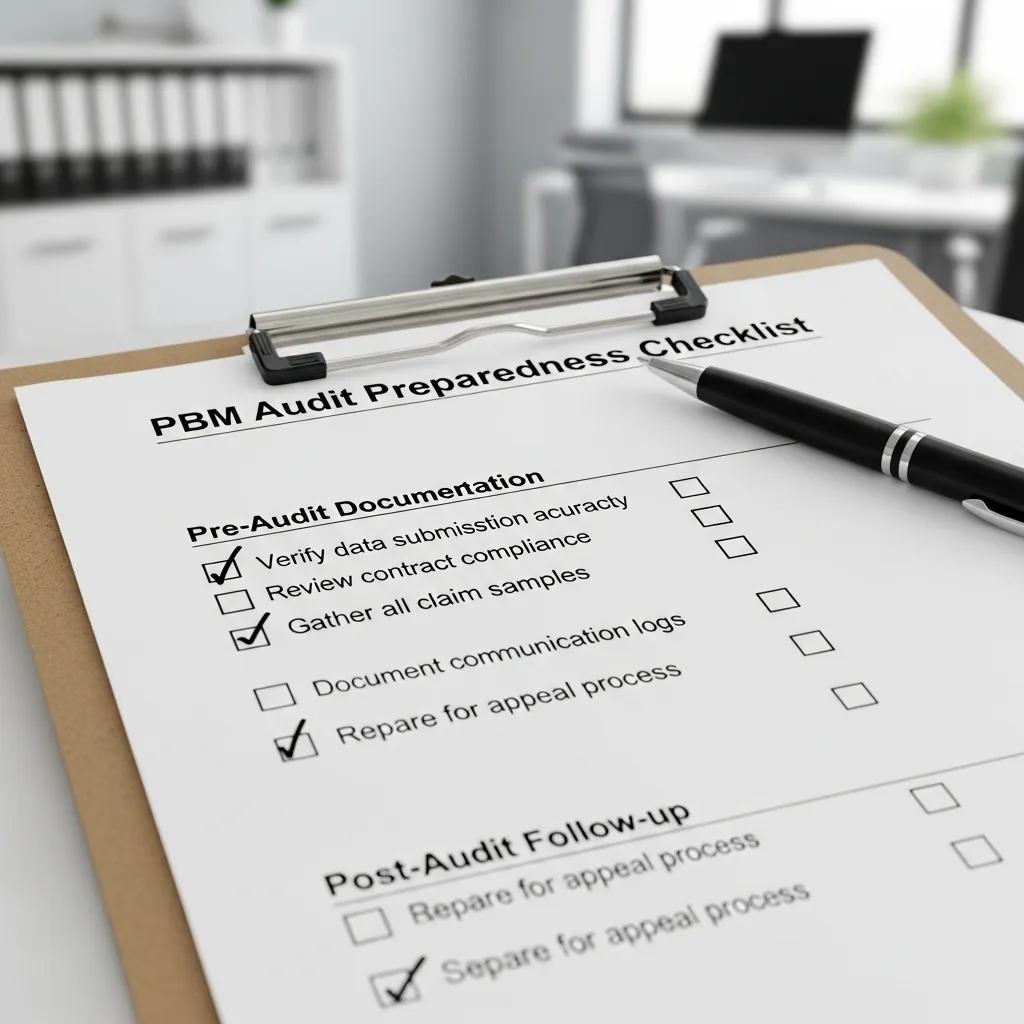
A PBM contract audit checklist is an essential tool for ensuring that all aspects of the contract are reviewed systematically. Key components of the checklist should include verifying pricing structures, reviewing claims for accuracy, and ensuring compliance with state regulations. By following a structured checklist, auditors can ensure that no critical areas are overlooked.
- Pricing Transparency — AWP discount percentages explicitly stated; MAC list accessible to employer on request
- Rebate Guarantees — Minimum rebate pass-through percentage specified (target: 100%); no undisclosed PBM rebate retention
- Spread Pricing Disclosure — All spread pricing disclosed in writing, or spread pricing contractually prohibited
- Audit Rights — Employer may conduct independent audit at least annually at no cost-shifting from PBM
- Claims Data Ownership — Employer owns 100% of claims data with full portability upon contract termination
- Formulary Control — Employer must approve material formulary changes; no unilateral PBM modifications
- Generic Substitution Rate — Contract guarantees minimum 85% generic dispensing rate
- Specialty Drug Pricing — Specialty markup transparently disclosed and capped at 5–10% maximum
- Network Adequacy — At least 90% of covered members within 5 miles of an in-network pharmacy
- Prior Authorization Turnaround — 24–48 hour PA decisions guaranteed for non-urgent requests
- Member Service SLAs — Call center answer times, complaint resolution, and escalation procedures defined
- Termination Clauses — 90-day notice allowed; no financial penalties for early exit; data portability guaranteed
- Performance Guarantees — Measurable savings targets with financial penalties for PBM non-performance
- Fee Transparency — All administrative, clinical, and technology fees itemized; no bundled or hidden fees
- Conflict of Interest Disclosures — PBM discloses all ownership interests, affiliated pharmacies, and manufacturer financial relationships
What Are the Best Practices for Pharmacy Claims Auditing in Michigan?
Best practices for pharmacy claims auditing in Michigan include conducting regular audits, utilizing consulting expertise to navigate complex contracts, and maintaining thorough documentation of all findings. These practices help ensure that audits are effective and that any identified issues can be addressed promptly.
What Are the Three Types of PBM Audits and Their Purposes?
Three audit types serve distinct purposes for Michigan employers:
- Financial Audit: Verifies pricing accuracy claim-by-claim — AWP discounts, rebate reconciliation, spread pricing calculations, MAC list accuracy, and administrative fee compliance. Typical findings for Michigan mid-market employers: $50,000–$200,000 in annual overcharges. Conduct annually, 60–90 days before contract renewal.
- Operational Audit: Evaluates PBM administrative performance — claims adjudication accuracy, prior authorization turnaround times, formulary management, network adequacy, and member service SLA compliance. Typical recoverable costs: $20,000–$75,000. Conduct every two years.
- Clinical Audit: Examines utilization management — specialty drug protocols, therapeutic alternatives, biosimilar substitution, step therapy compliance, and medication therapy management effectiveness. Typical savings potential: $30,000–$100,000 annually. Conduct every two to three years, or immediately after any year with pharmacy cost increases exceeding 10%.
How Do Michigan State Regulations Affect PBM Audits and Pharmacy Contracts?
Michigan state regulations play a significant role in shaping the landscape of PBM audits and pharmacy contracts.
Which Michigan Insurance Regulations Govern PBM Contract Compliance?
Several Michigan insurance regulations govern PBM contract compliance, including requirements for transparency in pricing and the obligation to disclose any potential conflicts of interest. Understanding these regulations is crucial for employers to ensure that their PBM is operating within the law and providing fair pricing.
Implementing robust regulatory frameworks and innovative models, such as Ohio’s pass-through PBM system, can be instrumental in detecting and preventing PBM overcharges and conflicts of interest.
PBM Overcharge Detection & Conflict of Interest
create a system that can catch PBMs who accidentally or purposely overcharge. Ohio’s pass-through PBM model, for example, unbundles functions of PBMs to identify and eliminate conflicts of interests.
Managing Benefits, Benefiting Iowa: Reducing State Spending on Prescription Drugs By Modernizing Iowa’s PBM Contracts, 2024
Michigan Public Act 185 of 2020 establishes mandatory PBM transparency requirements. All PBMs must register with Michigan Department of Insurance and Financial Services (DIFS) and submit annual disclosures of business practices and manufacturer financial relationships. PBMs must disclose all spread pricing in writing at the claim level, showing the difference between employer charges and pharmacy reimbursements. All manufacturer rebates and administrative fees must be fully disclosed, including the exact percentage retained versus passed through. Michigan law grants employers explicit statutory audit rights that PBMs cannot contractually waive — employers may engage independent auditors with full access to claims data, MAC lists, and rebate documentation. DIFS may impose civil penalties up to $10,000 per violation and revoke PBM registration for willful non-compliance. 2024 amendments expanded the definition of spread pricing, mandated real-time rebate reporting, and increased penalties, placing Michigan among the top five states for PBM transparency regulation. Employers should cite PA 185 in all PBM contracts and require written compliance certification at contract award and renewal.
How Do Regulatory Changes Influence PBM Audit Outcomes?
Regulatory changes can significantly influence PBM audit outcomes by altering the requirements for compliance and transparency. Recent changes in Michigan law may impose stricter guidelines on PBMs, making it even more critical for employers to stay informed and conduct regular audits to ensure adherence to these evolving standards.
How Can Employee Benefits Pharmacy Savings Be Maximized Through PBM Audits?
Maximizing savings through PBM audits involves identifying overcharges and negotiating better contract terms.
What Cost Savings Can Be Achieved by Identifying PBM Overcharges?
Identifying PBM overcharges can lead to substantial cost savings for employers. By uncovering hidden fees and negotiating more favorable terms, organizations can reduce their overall pharmacy benefit costs. Case studies have shown that companies can save thousands of dollars annually by conducting thorough audits and addressing discrepancies.
How Does Pharmacy Contract Negotiation Improve Employee Benefits?
Effective pharmacy contract negotiation can significantly enhance employee benefits by ensuring that employees have access to necessary medications at lower costs. By leveraging the insights gained from audits, employers can negotiate better terms that benefit both the organization and its employees, leading to improved satisfaction and retention.
What Are Real-World Case Studies Demonstrating Successful Michigan PBM Audits?
Real-world case studies provide valuable insights into the effectiveness of PBM audits.
Which Examples Show Significant Cost Recovery from PBM Audits?

Several Michigan companies have successfully recovered significant costs through PBM audits. For instance, one organization identified over $100,000 in overcharges related to hidden fees and incorrect pricing structures, demonstrating the potential financial impact of conducting regular audits.
What Lessons Can Be Learned from Pharmacy Contract Review Success Stories?
Success stories from pharmacy contract reviews highlight the importance of thorough audits and proactive negotiation strategies. Key lessons include the necessity of understanding contract terms, the value of consulting expertise, and the benefits of maintaining open communication with PBMs to foster transparency.
How Do Consulting Services Support Effective PBM Audits in Michigan?
Consulting services can play a crucial role in supporting effective PBM audits.
What Expertise Do Employee Benefits Consultants Provide for PBM Audits?
Employee benefits consultants offer specialized expertise in navigating the complexities of PBM contracts. They can assist organizations in identifying potential overcharges, understanding regulatory requirements, and developing effective audit strategies to maximize savings.
How to Choose the Right Consulting Partner for Your Pharmacy Contract Review?
Choosing the right consulting partner for pharmacy contract reviews involves evaluating their experience, expertise in the field, and track record of success. Organizations should seek consultants who have a deep understanding of Michigan regulations and a proven ability to identify and address PBM-related issues.
What Are Frequently Asked Questions About Michigan PBM Audits and Overcharges?
Addressing common questions can help demystify the PBM audit process.
What Is a PBM Audit and How Does It Save Money?
A PBM audit is a systematic review of pharmacy benefit manager contracts and claims to identify discrepancies and overcharges. By uncovering these issues, organizations can negotiate better terms and reduce their overall pharmacy costs, leading to significant savings.
What Steps Should Be Followed in a PBM Audit Process?
The PBM audit process typically involves several key steps: preparing for the audit by gathering relevant documents, executing the audit by reviewing claims and contracts, and taking post-audit actions to address any identified issues. Following these steps ensures a comprehensive review and maximizes the potential for cost recovery.
Key Takeaway: Pass-through pricing eliminates the conflict of interest in spread pricing and is the gold standard for Michigan employers seeking full pharmacy cost transparency.
To ensure you’re getting the best possible rates and coverage, consider exploring group health insurance options.
Many employers are also exploring alternative solutions like QSEHRA ICHRA to provide flexible benefits to their employees.
Understanding your employee benefits is crucial for both employers and employees to maximize value and satisfaction.
Beyond health coverage, it’s also important to consider dental vision plans to ensure comprehensive well-being for your team.
For more information or to discuss your specific needs, contact a benefits specialist today.
Protecting your employees with disability life insurance can provide financial security and peace of mind.
Recommended Audit Cadence
How Often Should Michigan Employers Conduct PBM Audits?
For mid-market Michigan employers (50–500 employees), CFH recommends: annual financial audits timed 60–90 days before renewal; operational audits every two years; clinical audits every two to three years. Trigger an immediate unscheduled audit if costs rise more than 10% year-over-year, if the PBM is acquired or merges, or if a material formulary change occurs without employer notification. Employers following this cadence recover an average of $85,000–$175,000 per audit cycle and maintain pharmacy cost trend increases below the Michigan market average of 8–12% annually.
About the Author
Sunny Connolly is the founder of CFH Insurance Consultants with over 30 years of experience in employee benefits and pharmacy cost containment for Michigan employers. She has conducted over 150 PBM audits for mid-market companies (50–500 employees), identifying an average of $75,000–$200,000 in annual overcharges. Sunny is a licensed Michigan insurance advisor, certified benefits consultant, and recognized expert in PBM contract negotiation and alternative funding strategies. Her clients span the automotive, manufacturing, and professional services sectors across Southeast and West Michigan. For more information, visit contact page.
Reviewed by: Michael Thompson, CEBS — Certified Employee Benefit Specialist with 15+ years of experience in pharmacy benefit management and PBM audit methodology. Michael has helped over 200 Michigan employers transition to transparent, pass-through PBM contracts and recover millions in overcharges. He specializes in stop-loss insurance, and alternative funding strategies for mid-market employers.