
What Is ICHRA? How Individual Coverage HRAs Work for Small Employers
The Individual Coverage Health Reimbursement Arrangement (ICHRA) is a flexible health benefits solution designed specifically for small employers. It allows businesses to provide employees with a defined contribution towards their health insurance premiums, enabling them to choose plans that best fit their individual needs. Employers looking for an alternative to conventional small business group benefits administration are increasingly turning to ICHRA for its flexibility and cost control. This innovative approach not only enhances employee satisfaction but also offers significant tax advantages for employers. As small businesses navigate the complexities of health benefits, understanding how ICHRA works and its benefits can empower them to make informed decisions. This article will explore the advantages of ICHRA for small employers, compare it with the Qualified Small Employer HRA (QSEHRA), and provide guidance on implementing an ICHRA plan effectively.
This emphasis on employee choice is a foundational element of ICHRA, distinguishing it from traditional group coverage options.
Related: how we help employers improve workforce health and control healthcare costs all year, not just at renewal.
ICHRA Benefits for Small Employers
ICHRA offers several key advantages for small employers looking to enhance their employee benefits package.
- Flexibility in Employee Benefits: Employers can customize their contributions based on employee needs, allowing for a more tailored approach to health benefits.
- Tax Advantages for Employers: Contributions made to ICHRAs are tax-deductible, providing financial relief for small businesses.
- Attracting and Retaining Talent: Offering ICHRA can make a company more attractive to potential employees, helping to retain top talent in a competitive job market.
The flexibility of ICHRA allows employers to set their contribution limits, which can vary based on employee age and family size. This adaptability ensures that businesses can manage their budgets while still providing valuable health benefits.
These benefits illustrate how ICHRA can serve as a strategic tool for small employers aiming to improve their health benefits offerings.
ICHRA vs QSEHRA: Key Differences
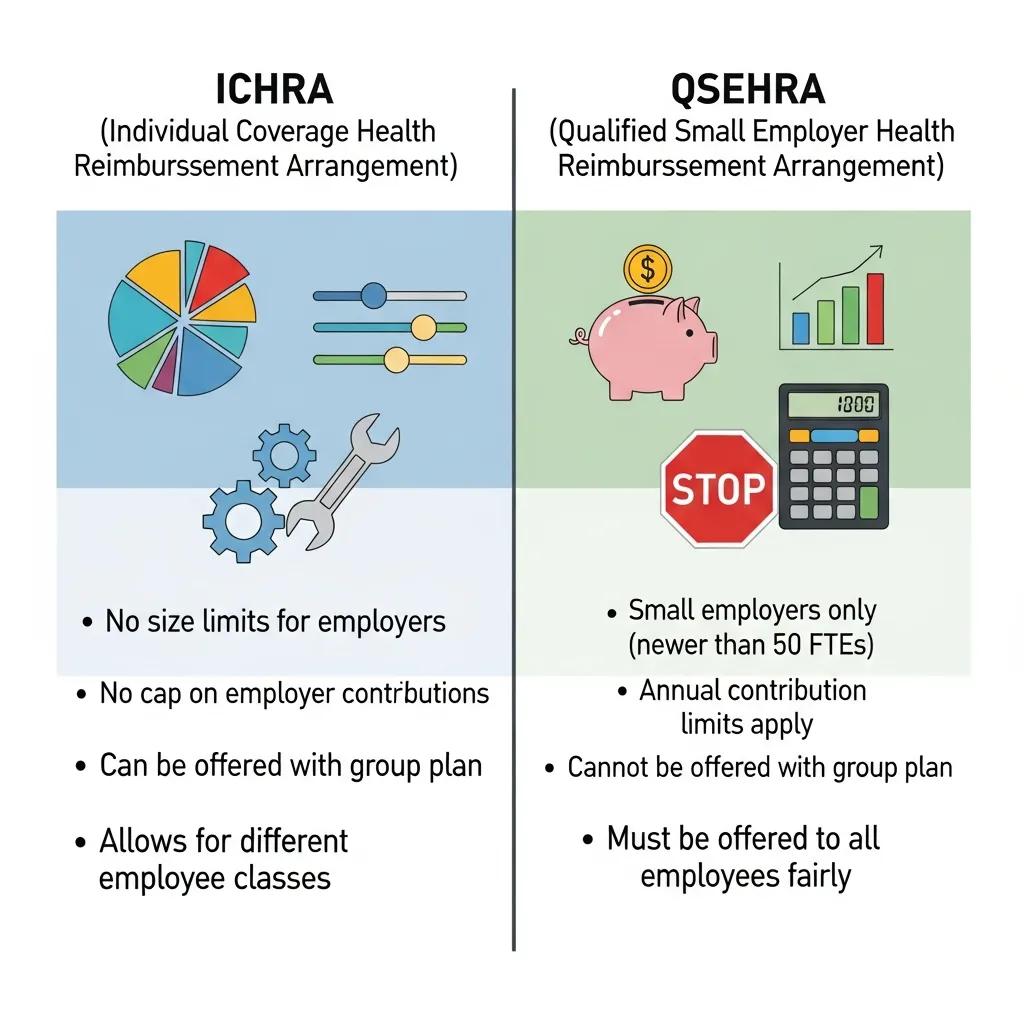
When comparing ICHRA to the Qualified Small Employer HRA (QSEHRA), several key differences emerge that can influence a small employer’s choice. Businesses with fewer than 50 employees that do not offer group coverage may qualify for a QSEHRA (Qualified Small Employer HRA), which has lower annual contribution limits but simpler administration.
- Eligibility Criteria Differences: ICHRA allows employers to offer benefits to all employees, while QSEHRA is limited to small employers with fewer than 50 full-time employees.
- Contribution Limits Comparison: ICHRA does not have a set contribution limit, allowing for more flexibility, whereas QSEHRA has specific annual contribution limits set by the IRS.
- Tax Implications: Both options provide tax advantages, but the specifics can vary based on the structure of the plan and the employer’s contributions.
Understanding these differences is crucial for small employers as they evaluate which health reimbursement arrangement best fits their needs.
How to Implement an ICHRA Plan

Implementing an ICHRA plan involves several key steps that small employers should follow to ensure compliance and effectiveness.
- Define Contribution Levels: Employers should determine how much they will contribute to each employee’s health insurance.
- Choose Eligible Employees: Decide which employees will be eligible for the ICHRA, as employers can offer different plans to different groups.
- Communicate with Employees: Clearly explain the ICHRA benefits and how employees can use their reimbursements for health insurance premiums.
For small businesses looking for assistance in setting up an ICHRA plan, consulting services offered by “CFH Insurance Consultants” can provide tailored guidance and support throughout the implementation process.
ICHRA Compliance and IRS Guidelines
Compliance with IRS guidelines is essential for the successful operation of an ICHRA. Employers must adhere to specific reporting requirements and ensure that their plans meet all regulatory standards.
- IRS Regulations for ICHRA: Employers must provide a written notice to employees detailing the ICHRA’s terms and conditions.
- Reporting Requirements: Employers are required to report contributions and reimbursements to the IRS, ensuring transparency and compliance.
- Penalties for Non-Compliance: Failure to comply with IRS regulations can result in significant penalties, making it crucial for employers to stay informed and compliant.
By understanding these compliance requirements, small employers can avoid potential pitfalls and ensure their ICHRA plans operate smoothly.
When an ICHRA Works, and When It Does Not
An ICHRA is a good fit for some employers and a poor one for others, and the deciding factors are fairly predictable.
It tends to work when
- The individual market in your county has several carriers and a real spread of plans, so employees have genuine choice rather than one option.
- Your workforce is spread across counties or states, where a single group network would serve some employees badly.
- Predictable cost matters more to you than offering a single uniform plan — your exposure is the contribution you set, so it does not move at renewal.
- You have employee classes with genuinely different needs, since an ICHRA can set different contribution amounts by permitted class.
It tends not to work when
- The individual market where your employees live is thin, or the available networks exclude the health systems they use.
- Your employees would lose access to a group plan that is currently richer than what your contribution would buy them on the individual market.
- A substantial share of your employees qualify for premium tax credits on the exchange — an ICHRA offer that is considered affordable disqualifies them from those credits, which can leave them worse off.
- Your team does not have the capacity to support employees selecting their own plans for the first time, which is the part employers consistently underestimate.
The comparison that settles it is your current group rates against what your intended contribution actually buys on the individual market for your employees’ ages and ZIP codes. That is a calculation on your own numbers, not a general rule.
Questions We Get
Can we offer an ICHRA to some employees and a group plan to others?
Yes, but only along permitted class lines — full-time versus part-time, salaried versus hourly, or by location, among others — and the same class cannot be offered both. Class sizes have minimums when the classes are based on certain criteria. This is an area where the design has to be documented carefully before the plan year starts.
Is a QSEHRA a good fit for a small employer?
It can be, for employers with fewer than 50 employees who do not offer a group plan. A QSEHRA reimburses employees tax-free for individual premiums and qualified medical expenses, up to annual limits the IRS sets. It gives budget certainty, because the employer decides the contribution. The trade-off is that employees buy their own coverage, which works well for some workforces and poorly for others.
Unhappy with your current broker? Switch to CFH. Your employees won’t notice. You will.
