

By CFH Insurance Consultants, CFH Insurance Consultants
Employers in Michigan navigate a detailed and often complex landscape of federal regulations concerning employee benefits, most notably the Employee Retirement Income Security Act (ERISA). Understanding and achieving ERISA compliance is fundamental not only to avoid significant penalties but also to maintain trust and transparency with employees regarding their benefits. This authoritative guide offers Michigan employers an in-depth analysis of ERISA compliance key areas: Summary Plan Description (SPD) requirements, Form 5500 electronic filing (EFAST2), the Delinquent Filer Voluntary Compliance Program (DFVCP), fiduciary responsibilities, and ongoing best practices.
The agency that enforces these rules is EBSA; see what EBSA is and what it asks for in an investigation.
Related: how we help employers improve workforce health and control healthcare costs all year, not just at renewal.
ERISA Compliance Checklist for Michigan Employers
The ERISA compliance checklist is an essential tool that helps Michigan employers meet their legal obligations related to employee benefit plans and fosters effective benefit plan administration. It ensures that retirement and health plans meet regulatory standards, minimizing risk while enhancing transparency and fostering a productive employer-employee relationship.
1. Summary Plan Descriptions (SPDs) Requirements

One of the foundational ERISA requirements for Michigan employers is providing Summary Plan Descriptions (SPDs) to employees. SPDs communicate the terms, benefits, participant rights, and administrative procedures of employee benefit plans.
SPD Delivery Deadlines and Contents
- Employers must deliver SPDs within 90 days of an employee’s enrollment into the plan.
- The SPD must clearly describe plan benefits, eligibility rules, claim procedures, and participant rights in understandable language.
- Failure to provide an SPD or to respond to a written SPD request can incur penalties exceeding $110 per day for each affected participant.
ERISA Wrap Plan Documents vs. Carrier Booklets
It is crucial to understand that carrier benefit summaries and certificates of coverage alone do not meet Department of Labor (DOL) audit standards. These documents typically lack:
- Statutory ERISA language
- Claims and appeals procedures
- Plan administrator definitions
- Subrogation clauses and other required provisions
An ERISA wrap plan document legally consolidates various plan components—such as medical, dental, vision, life insurance, disability, Flexible Spending Accounts (FSAs), and Health Reimbursement Arrangements (HRAs)—under one unified plan number. This bundling ensures full compliance by covering statutory language and procedural requirements absent in carrier booklets.
Preparing and Updating SPDs and Wrap Documents
Regularly updating SPDs and ERISA wrap plan documents to reflect changes in benefit design, regulatory updates, or vendor adjustments is vital for maintaining compliance and providing employees with accurate, timely information.
2. Form 5500 Filing and Reporting Deadlines
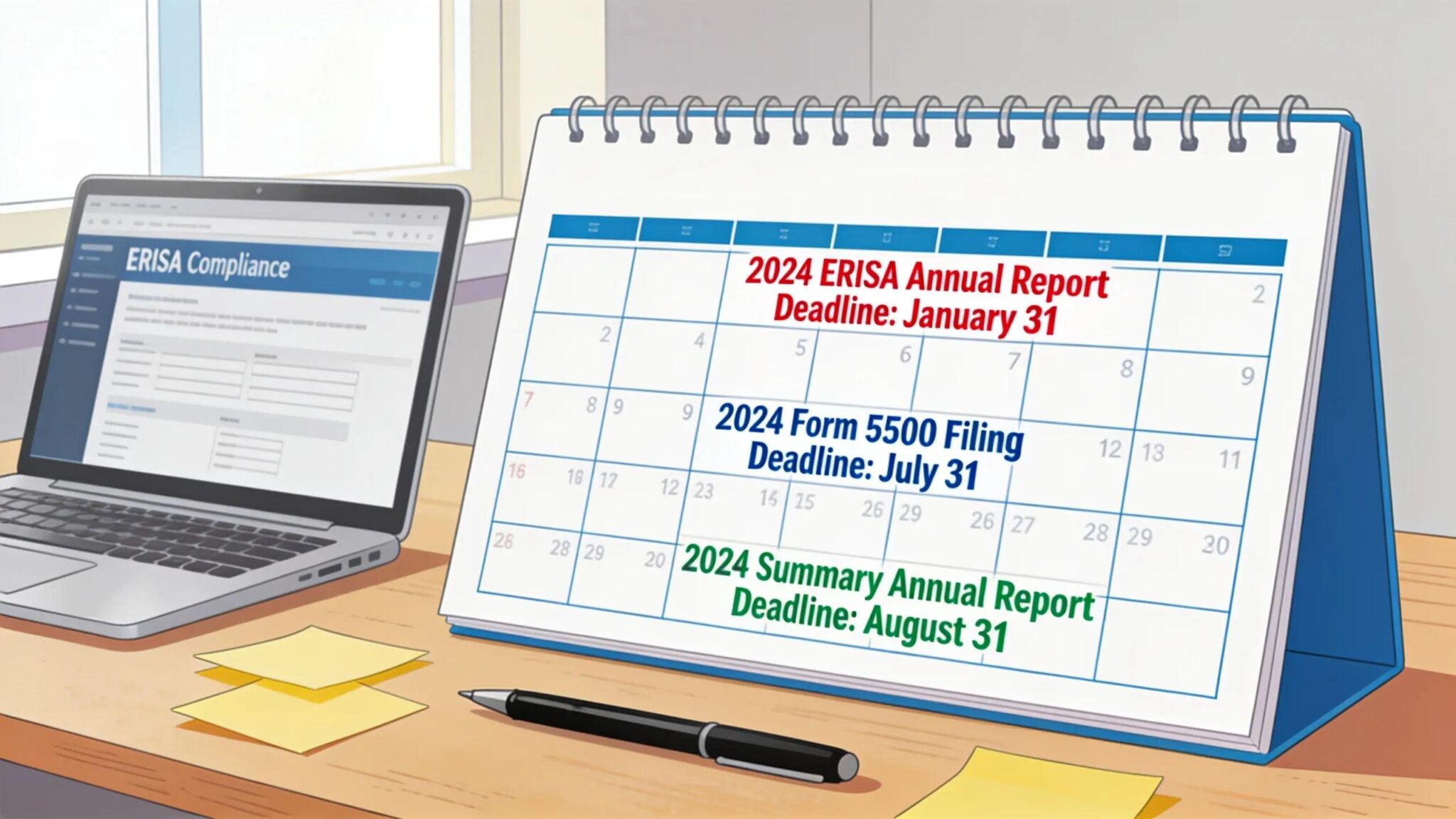
Annual reporting via Form 5500 is a cornerstone ERISA compliance requirement ensuring transparency and regulatory oversight of benefit plans.
Understanding Filing Tiers: Small vs. Large Welfare Plans
Michigan employers must recognize differences in filing obligations based on plan size:
- Small Welfare Benefit Plans: Plans with fewer than 100 covered participants on the first day of the plan year may file the simplified Form 5500-SF. These plans have reduced reporting requirements.
- Large Welfare Benefit Plans: Plans with 100 or more participants must file the full Form 5500 along with Schedule A (insurance information) and Schedule C (service provider compensation disclosures).
Form 5500 Electronic Filing (EFAST2)
All Form 5500 filings must be submitted electronically via the EFAST2 system, an online portal managed by the Department of Labor. E-filing ensures secure, timely submissions and instant confirmation of receipt.
Filing Deadlines
- Form 5500 is due by the last day of the seventh month after the plan year ends (typically July 31 for calendar-year plans).
- Missing this deadline can trigger substantial penalties, increasing daily with each late day.
Delinquent Filer Voluntary Compliance Program (DFVCP)
To mitigate catastrophic penalties from late or non-filing of Form 5500, employers can participate in the Delinquent Filer Voluntary Compliance Program (DFVCP). This program allows non-compliant plans to file late returns with greatly reduced penalties if done voluntarily before enforcement action.
Amendments and Recordkeeping Deadlines
Employers must also adhere to ERISA deadlines for plan amendments and maintain comprehensive records supporting benefit plan filings for a minimum of six years to satisfy audit requirements.
3. Important ERISA Compliance Deadlines Calendar
4. DOL Penalties and Non-Compliance Risks
5. Fiduciary Liability and Governance
ERISA imposes strict fiduciary duties on plan administrators and trustees, governed primarily by Section 404(a). Michigan employers acting as fiduciaries must adhere to the prudent person standard and the exclusive purpose rule:
- Prudent person standard: Fiduciaries must act with the care, skill, and diligence that a prudent person would exercise under similar circumstances.
- Exclusive purpose rule: Fiduciaries must act solely in the interest of plan participants and beneficiaries for the exclusive purpose of providing benefits and defraying reasonable expenses.
Fiduciary Bonds vs. Fiduciary Liability Insurance
These are distinct protections addressing different risks:
- ERISA Fidelity Bonds are mandatory and protect plan assets against fraud and theft by persons handling plan funds.
- Fiduciary Liability Insurance is optional but strongly recommended, protecting plan fiduciaries—trustees, officers, and directors—from personal liability arising from breaches of fiduciary duty.
6. Strategies for Ongoing ERISA Compliance
To maintain compliant benefit plans in Michigan, consider adopting the following strategies:
- Regular Compliance Audits: Conduct thorough audits to identify and correct any compliance gaps before regulatory inquiries.
- Efficient Deadline Tracking: Utilize software or calendar systems to monitor all ERISA and related reporting deadlines precisely.
- Employee Education: Provide ongoing training and clear communication about employee rights and benefits, reducing confusion and disputes.
- Work with Expert Advisors: Partner with firms like CFH Insurance Consultants, specializing in Michigan employee benefits and ERISA compliance, to conduct audits, generate ERISA wrap plan documents, and manage annual notice schedules.
Key Takeaways
- Deliver accurate and updated Summary Plan Descriptions (SPDs) and utilize an ERISA wrap plan document to meet DOL requirements.
- File Form 5500 electronically via EFAST2, distinguishing small vs. large welfare plans and avoid penalties by timely filings.
- Leverage the Delinquent Filer Voluntary Compliance Program (DFVCP) to reduce penalties for late Form 5500 filing.
- Understand and comply with important annual deadlines including CHIPRA and Medicare Part D notices.
- Comply with fiduciary duties under Section 404(a), and secure proper fiduciary liability insurance and bonds.
- Engage expert advisors such as CFH Insurance Consultants for specialized Michigan-focused ERISA compliance support.
7. Frequently Asked Questions (FAQs)
Why can’t I just rely on my insurance carrier’s benefit booklet for ERISA compliance?
A: Insurance carrier booklets lack required DOL-mandated language such as claims procedures, plan administrator designations, and subrogation clauses. An ERISA wrap plan document is necessary to legally bundle and supplement these benefits under one ERISA-compliant plan framework.
What is the difference between a small and large welfare benefit plan for Form 5500 filing?
A: If you have fewer than 100 participants on the first day of the plan year, you can file the simplified Form 5500-SF. Plans with 100 or more participants must file the full Form 5500 with additional schedules.
How can I electronically file Form 5500?
Electronically file all Form 5500 submissions through the Department of Labor’s EFAST2 system at www.efast.dol.gov.
What can I do if I missed the Form 5500 filing deadline?
You should explore the Delinquent Filer Voluntary Compliance Program (DFVCP), which allows you to voluntarily file delinquent returns with reduced penalties before enforcement actions begin.
What are my fiduciary responsibilities as a plan sponsor under ERISA?
You must adhere to the Section 404(a) fiduciary standards, acting prudently, loyally, and exclusively in the interest of participants and beneficiaries, avoiding conflicts of interest and managing plan assets responsibly.
How can CFH Insurance Consultants assist with ERISA compliance?
CFH Insurance Consultants specializes in the Michigan market by conducting detailed ERISA compliance audits, generating legally compliant ERISA wrap plan documents, managing annual notice deliveries like SPDs and CHIPRA, and advising on fiduciary risk mitigation, helping employers stay compliant with confidence.
Need Assistance with ERISA Compliance?
If your Michigan-based organization requires expert guidance for ERISA compliance, including preparation of SPDs, form filings, and fiduciary liability management, contact our team of specialized insurance consultants for personalized support.
Questions We Get
The questions employers ask us most are answered in full on our resources page.
Unhappy with your current broker? Switch to CFH. Your employees won’t notice. You will.
