
One Earner, One Plan, and a Household of Four
Hamtramck’s census figures are unlike anywhere else an employer in this region hires. The average household holds 3.86 people. More than thirty-five percent of residents are under eighteen, while barely eight percent are sixty-five or older. Civilian labor force participation sits at about forty-five percent overall and under twenty-seven percent among women.
Employers looking beyond the next quote can start with our health and cost strategy for fully insured plans.
Read those four numbers together and a structure appears. A large share of Hamtramck households are supported by one working adult carrying several dependents, in a city where the median household income is a little over thirty-nine thousand dollars and roughly forty percent of residents live below the poverty line. Eleven percent of residents under sixty-five have no health coverage at all.
For an employer, this is not background color. It means the group health plan you offer is frequently the only private coverage an entire family has. There is no spouse’s plan quietly absorbing what yours excludes.
A Claims Profile That Is Mostly Children
A plan covering households of this shape spends its money differently from one covering a typical suburban group. Well-child visits, immunizations, ear infections, asthma, adolescent behavioral health, orthodontia questions at every open enrollment. What it spends very little on is the chronic cardiac and oncology load that drives cost in an older workforce, because that population is barely present here.
That profile is genuinely cheaper in aggregate, and employers should expect to see it reflected. What it is not is stable. A small group carrying a lot of dependents is exposed to the high-cost pediatric events that arrive without warning, a complicated delivery or a neonatal stay among them, and one of those can move a year’s experience on a group of thirty.
The practical consequences are in the details rather than the headline rate. Pediatric dental and vision are embedded essential benefits on small-group plans, and an employer who does not know that sometimes buys a separate children’s dental policy they were already paying for. Whether the plan’s pediatric specialists are reachable without a long trip matters more here than the size of the hospital network.
There Is No Second Plan to Coordinate With
Most benefits advice quietly assumes a second plan somewhere in the household. Coordination of benefits rules, the birthday rule for children covered twice, the calculation of whether a spouse should waive your plan for theirs, the surcharge an employer adds when a spouse has coverage available elsewhere. In a city where fewer than half of adults are in the labor force, a great many of those conversations have no second side.
That changes what the plan has to do. Every exclusion is a real exclusion. A narrow network is not softened by a spouse’s broader one. A high deductible is not partly absorbed somewhere else, and an out-of-pocket maximum is the household’s actual worst case rather than one of two ceilings.
It also changes the employer’s position for the better in one specific way. A group where nobody has an alternative is a group where participation is high and stable, and high participation is the condition most carriers price around. An employer here is often in a stronger underwriting position than they realize, and it is worth making sure the carrier is being asked to reflect that rather than applying a default assumption about a group this size.
Affordability at a Thirty-Nine Thousand Dollar Median
An employee contribution that reads as reasonable in Oakland County can be the reason a Hamtramck household declines coverage. The federal affordability test looks only at the cost of covering the employee alone, which means an employer can pass it comfortably while the family tier remains entirely out of reach for the person it was designed for.
What follows is predictable. The employee enrolls alone, the children go elsewhere for coverage, and the employer concludes that nobody here wants family benefits. The plan that results is smaller than it should be and the employer is paying administrative cost on an enrollment they did not intend.
The structural fixes cost less than the problem. Weighting the employer contribution more heavily toward the dependent tiers rather than spreading it evenly. Offering a second, leaner plan so that a family has something reachable rather than a single option priced beyond them. Moving from a flat dollar contribution to a percentage so the employer’s share scales with the tier. Each of these has to be tested against the real census, because on a payroll with households this size the averages are misleading in both directions.
Language Access Is a Requirement, Not a Courtesy
Nearly three-quarters of Hamtramck residents speak a language other than English at home and close to half were born outside the United States. Most employers here already know that. Fewer know that parts of it are written into the rules rather than left to good intentions.
The summary of benefits and coverage carries a language-tagline obligation tied to the county the employee lives in, and the threshold is reassessed rather than fixed, so it is worth checking against the current federal county list each year rather than assuming last year’s answer holds. Separately, health plans and the providers in them carry their own obligations around notifying people that language assistance is available and providing it at no cost.
The compliance floor is not the useful part. The useful part is that a person who cannot read the enrollment packet does not enroll, or enrolls in the wrong tier, or does not understand that the preventive visit is already paid for. We would rather an employer spend money on a short, translated summary of what things cost than on a thirty-page booklet in one language that most of the workforce will not open.
Outpatient Care in Town, Inpatient Care Outside It
Hamtramck packs better than thirteen thousand people into each of its two square miles, which makes it the most densely populated municipality in Michigan and means almost everything is walkable. Henry Ford operates an outpatient medical center inside the city, so routine care does not require leaving it. Inpatient care does. Every hospital option sits across the line in Detroit, which is a short distance and a meaningful difference for a household without a second car.
That geography argues for looking hard at the plan’s urgent care and virtual care terms, which are the provisions most likely to keep a family out of an emergency department for something a clinic handles. Emergency department cost-sharing is where a plan that looked affordable turns into a bill that convinces a household the coverage was worthless.
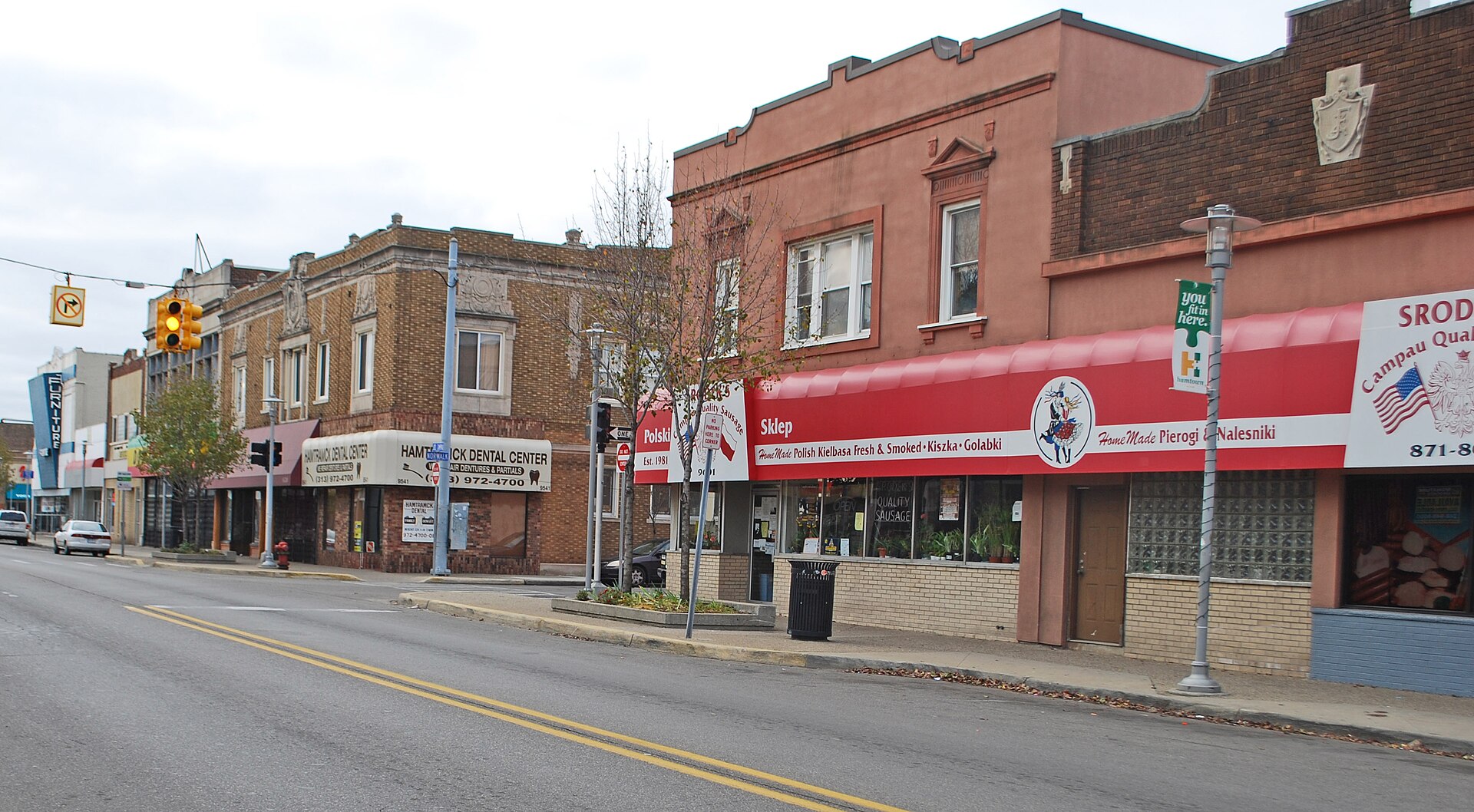
The employer side of the city is mostly small. Hamtramck’s business base runs to independent storefronts, restaurants and service operations rather than large payrolls, which puts most employers squarely in the small-group market with its participation minimums and its limited room to negotiate. That is a constraint, not a dead end. It mainly means the decisions that are available, the tier structure, the contribution strategy and the network, have to carry more weight because the ones that are not available cannot.
Small Employers in a Dense Enclave City
Here is the fact that decides how a benefits plan should be built in Hamtramck: the city’s largest private employer has 158 employees. The city’s own 2025 Main Street application lists its biggest private employers as 18th Street Deli (158), St. Joseph Health Care Center (131) and Caniff Electric Supply (85). The genuinely largest employers are Hamtramck Public Schools (about 478 staff) and the City of Hamtramck.
GM’s Factory ZERO sits on the Detroit–Hamtramck border, but GM files it at a Detroit address, so we do not count it as a Hamtramck employer. It is also contracting rather than growing: a November 2025 WARN notice covered 1,140 permanent hourly layoffs effective January 2026, citing slower near-term EV adoption.
The workforce profile is unlike anywhere else in Michigan. 46.7% of residents are foreign-born, 73.5% speak a language other than English at home, and 35.2% are under 18. Median household income is $39,293. Practically, that means enrollment material has to work in more than one language, and for most employers here the right conversation is small-group design and marketplace coordination rather than large-group medical.
Quick Answers for Hamtramck Employers
Does CFH work with Hamtramck firms?
Yes. We advise Hamtramck employers on plan design, carrier and funding comparisons, renewal negotiation, compliance and enrollment. We are licensed insurance brokers who weigh cost, plan performance, risk and administration together, and we typically start with your current plan and renewal.
A plan that has to carry the whole household and was never designed to? See how a switch to CFH works.
Send Us the Census and the Hamtramck Renewal
Send the renewal letter, plan summary, contribution split and enrollment by tier, plus two more documents at fifty or more and your census, and we will show what the number is made of. 248.370.8853 or info@cfhic.com.
Start the Review Email info@cfhic.com Call 248.370.8853
An independent employee benefits consulting firm. We look at the entire benefits program — cost, plan performance, risk and administration.
Bloomfield Hills, MI 48304
248.370.8853
Colorado Springs, CO 80921
719.425.2649
Houston, TX 77084
281.404.5670
