
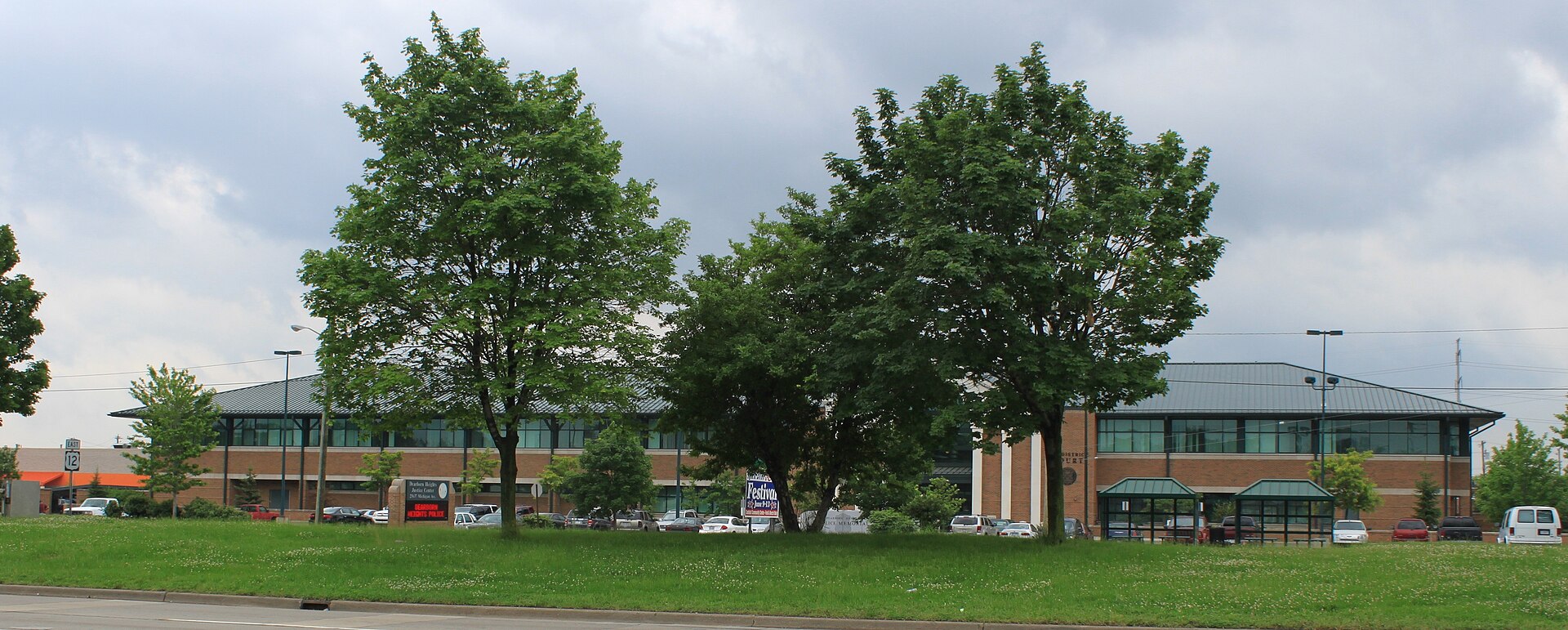
Six School Districts in One City
Dearborn Heights is split among six school districts, which is unusual even by Michigan standards. For an employer that is more than trivia: staff live across a wide set of attendance boundaries, follow different school calendars, and commute in several directions.
Practically it argues for network breadth rather than tiering toward one hospital system, and for a summer staffing plan that does not assume everyone’s children are off in the same weeks. Small operational details, but they show up in time-off patterns and in enrollment participation.
Your Benchmark Is Dearborn, Not Dearborn Heights
Ford dedicated its new world headquarters in Dearborn in November 2025 — around 2.1 million square feet with capacity for roughly four thousand employees, and Ford says fourteen thousand people will work within a fifteen-minute walk of the hub when it is complete. Corewell Health Dearborn, with 632 beds, sits nearby.
Related: how we help employers improve workforce health and control healthcare costs all year, not just at renewal.
An employer in Dearborn Heights recruits against both. That does not mean matching them; it means funding the visible parts of a package well — an employer contribution to a health savings account, dental that covers major services, a disability benefit that pays — rather than spreading the same money invisibly across a medical premium.
Plan Structures for a Wage-Sensitive Workforce
Fully Insured Under Twenty-Five Lives
With community rating, one bad claims year does not sink a small group. Below roughly twenty-five employees this is often the right choice, and we will tell you when it is.
Level Funding for Healthier Groups
When your employees run healthier than the pool, a level-funded plan ends that subsidy at a fixed monthly cost and may return a surplus. Underwriting applies.
Two Plans Side by Side
Pair a richer plan with one that takes very little out of each paycheck. In a wage-sensitive workforce that raises participation more than a bigger employer contribution does.
A Network as Wide as Your Commute Map
With employees spread across several communities and no hospital in the city, breadth generally beats tiering toward one system.
Compliance Points Dearborn Heights Employers Miss
Test Affordability at the Lowest Wage
Affordability is measured against your lowest-paid full-time employee, not your average pay rate.
Look-Back Measurement for Hourly Staff
Variable-hour retail and service staff need a written look-back measurement, administrative and stability period.
The Fifty-Employee Count Across Entities
The employer mandate counts full-time equivalents across every commonly owned company, not just the staff at one address.
Enrollment Materials
This is a linguistically diverse workforce. Carriers will produce translated enrollment materials on request, and asking usually improves participation and accuracy.
Dearborn Heights Employers Often Ask
Can enrollment materials be translated?
Yes. Most carriers and enrollment platforms will produce Arabic-language materials and provide interpreter support during an enrollment window. It has to be requested, and it reliably improves both participation and enrollment accuracy.
Where do our employees go for hospital care?
There is no hospital in the city. Corewell Health Dearborn at 632 beds is the nearest large facility, with Garden City Hospital and Corewell Wayne also close. Check all three in any network you compare.
Public Sector, Six Districts and the Ford Corridor
Dearborn Heights had 63,292 residents at the 2020 census across just under twelve square miles. City government has historically been described as the largest employer and H.Y.P.E. Athletics Community, a youth and community recreation organization on West Warren Avenue, as the second with more than two hundred employees — though both figures date from 2014 and should be treated as indicative rather than current. Crestwood School District, headquartered on North Gulley Road, runs six schools with around 462 full-time-equivalent staff. The city is unusually fragmented for education: six districts serve parts of it, including Dearborn Heights School District No. 7, Westwood Community Schools, Dearborn Public Schools, Wayne-Westland and Taylor. Many Arab-owned businesses based in Dearborn operate branches here. There is no hospital in the city; Corewell Health Dearborn has 632 beds, Garden City Hospital 309 and Corewell Health Wayne 185.
The Employer Figures Are a Decade Old
The only published ranking for this city dates from 2014. Useful for shape, not for a current benchmark — and worth saying so rather than presenting it as current.
Ford’s New Campus Is Next Door
A new world headquarters in Dearborn with capacity for around four thousand people reshapes the local labor market a few minutes away.
Translation Is Worth Asking For
In a workforce this multilingual, English-only enrollment materials cost you participation and create misenrollment. Carriers will translate on request.
Western Wayne Neighbors We Also Serve
- Employee benefits in Dearborn
- Employee benefits in Inkster
- Employee benefits in Garden City
- Employee benefits in Westland
- Employee benefits in Taylor
- Employee benefits in Allen Park
- Employee benefits in Livonia
All Detroit metro cities we serve · Every Michigan city we serve
Other Questions From Dearborn Heights
Does CFH advise employers in Dearborn Heights?
Yes. We help Dearborn Heights employers with plan design, carrier and funding comparisons, renewals, compliance and enrollment. We are licensed insurance brokers, and for proper coverage of an account we work in teams of five. The usual first step is a review of your current plan and renewal.
Can we get enrollment materials in Arabic for our staff?
Yes. Most carriers and enrollment platforms will produce Arabic-language enrollment materials and provide interpreter support during an enrollment window. It has to be requested, and in a workforce as multilingual as this one it usually improves both participation and enrollment accuracy enough to be worth the ask.
Is a second opinion possible while we keep our broker?
It is, and it is free. Nothing has to change. We will show you what the increase is made of and whether a better option exists, and if your current program is fairly priced, we will tell you so.
Recruiting next to Ford’s new campus with a plan nobody has revisited? See how switching to CFH works.
Send Us the Renewal, Not Just the Rate
Share the renewal letter, the plan summary, your contribution and enrollment by tier, and two more documents if you are at fifty or above, and we will tell you exactly what the increase contains. 248.370.8853 or info@cfhic.com.
Start the Review Email info@cfhic.com Call 248.370.8853
An independent employee benefits consulting firm. We look at the entire benefits program — cost, plan performance, risk and administration.
Bloomfield Hills, MI 48304
248.370.8853
Colorado Springs, CO 80921
719.425.2649
Houston, TX 77084
281.404.5670
Related Guides
Service Areas
Employee benefits guidance for employers in every region of Michigan we serve.
Small Group Health Insurance Guide for Michigan Employers (2 to 50 Employees)
How small group health insurance works in Michigan and how to compare your options.
Employer Benefits Guides: Eligibility, Plan Design, Life Events and Rules
Our library of plain-English guides on eligibility, plan design and compliance.
