

By CFH Insurance Consultants, CFH Insurance Consultants
What Are QSEHRAs and ICHRAs, and How Do They Differ? A Health Reimbursement Arrangement Comparison 2026 Perspective
Navigating the landscape of health reimbursement arrangements (HRAs) can be challenging for Michigan employers, especially when determining the best fit amid evolving regulations and contribution limits. With options like the Qualified Small Employer Health Reimbursement Arrangement (QSEHRA) and the Individual Coverage Health Reimbursement Arrangement (ICHRA), understanding the key differences is crucial for making informed decisions that comply with ACA requirements and local regulations.
This article provides a detailed Individual Coverage HRA vs Qualified Small Employer HRA analysis tailored for Michigan small businesses. We’ll explore eligibility criteria, contribution limits including the 2026 projections, tax implications, and compliance frameworks under Michigan small business HRA regulations. Our goal is to guide you through the complexities so you can confidently choose the right plan design and optimize health benefits for your workforce with tax-free employee insurance reimbursement Michigan advantages.
What Are the Eligibility Requirements for QSEHRA and ICHRA?
Understanding employee eligibility and employer business size thresholds is foundational. QSEHRA eligibility is strictly for small employers with fewer than 50 full-time equivalent employees, prohibiting simultaneous offering of group health plans. This makes QSEHRA an excellent option for small Michigan firms seeking simple health reimbursement arrangements without group plan complexities.
Conversely, ICHRA accommodates employers of any size, from startups to large corporations, offering expansive flexibility in benefit design and employee classification. This makes the QSEHRA vs ICHRA Michigan employers decision hinge on both workforce size and the desired customization level of health benefits.
How Do Contribution Limits and Flexibility Differ? A Breakdown Including 2026 Updates
For 2023, QSEHRA contribution limits are federally capped at $5,850 for individual coverage and $11,800 for family coverage. These caps are expected to adjust annually; importantly, for 2026, the health reimbursement arrangement comparison 2026 projects incremental inflation-based increases, which employers must monitor continually.
ICHRA, in contrast, imposes no statutory contribution caps. Employers can set varied reimbursement amounts based on employee class eligibility, providing scalable benefit models aligned with business budgets and workforce diversity. This flexibility supports more nuanced benefit programs beneficial for companies with varied employee needs.
What Are the Tax Implications for Employers and Employees?
Both QSEHRA and ICHRA reimbursements are considered tax-free for employees in Michigan, and employer contributions are deductible business expenses. These tax advantages make HRAs compelling tools for offering employee benefits while managing costs and maintaining ACA compliance HRA Michigan standards.
Employee Eligibility Criteria and Business Size Decision Frameworks in Michigan
When choosing between HRAs, Michigan employers should evaluate their workforce structure. Businesses with less than 50 full-time employees benefit from the simplicity of QSEHRA, while larger businesses or those anticipating growth should consider ICHRA’s customizable plans designed to cater to diverse employee classifications, including full-time, part-time, seasonal, and location-based groups.
How Do Health Reimbursement Arrangements Benefit Michigan Small Businesses?
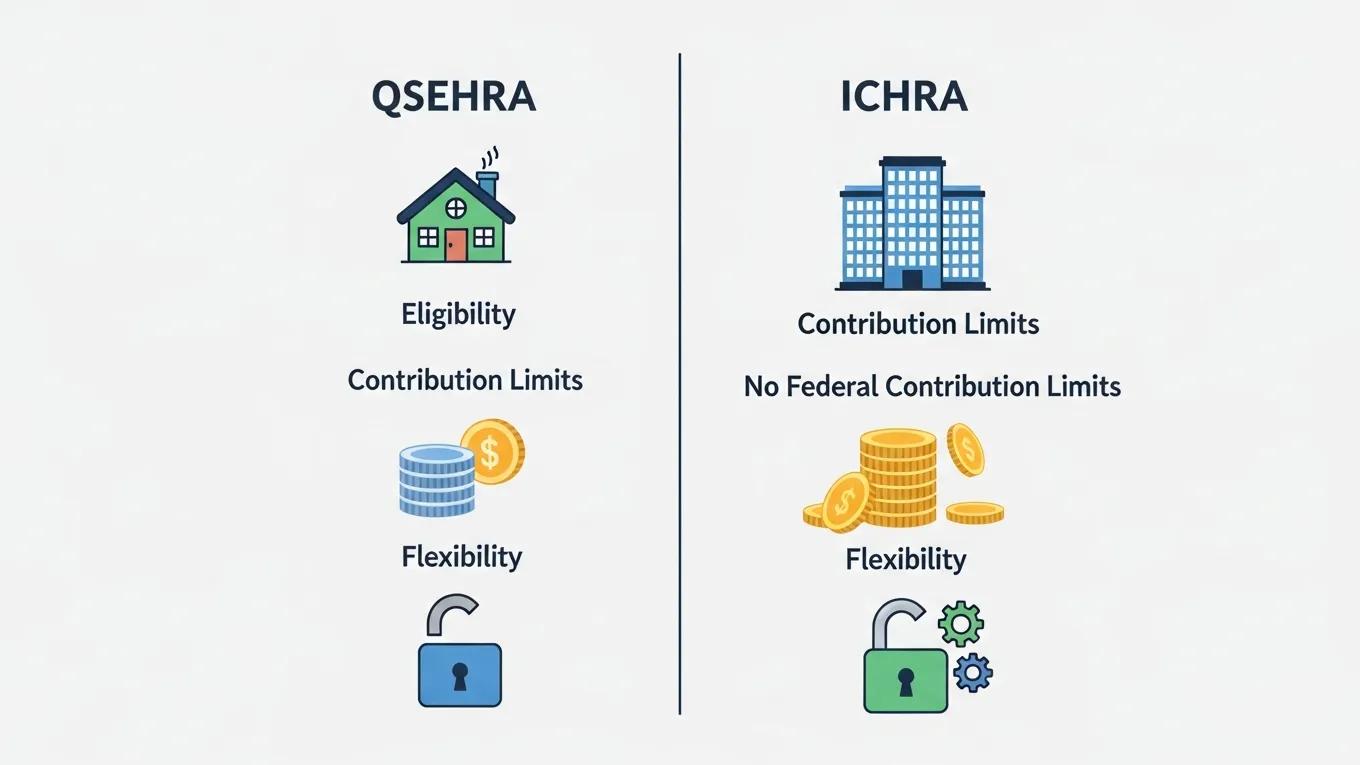
To clarify the differences between QSEHRA and ICHRA for Michigan employers, the following table presents a comprehensive comparison matrix including recent updates, 2026 contribution limit breakdowns, and compliance factors:
QSEHRA vs. ICHRA: Which HRA Is Right for Your Michigan Workforce?
Choosing between QSEHRA and ICHRA involves weighing:
1. Business Size and Growth Projections
- QSEHRA: Opt for QSEHRA if you have fewer than 50 full-time employees with no plans for rapid growth.
- ICHRA: Choose ICHRA if your business exceeds 50 employees or anticipates expansion, needing scalable health benefit solutions.
2. Contribution Limits and Budget Management
- QSEHRA: Favorable for employers preferring fixed, IRS-capped reimbursements for cost predictability.
- ICHRA: Ideal for employers wanting flexible reimbursement amounts tailored to employee classifications without contribution caps.
3. Plan Customization Needs by Employee Classes
- QSEHRA: Provides a one-size-fits-all plan; simplicity over customization.
- ICHRA: Enables class-based customization—such as different benefits for full-time vs part-time employees or geographic considerations, supporting diverse workforce strategies.
4. Workforce Demographics and Diversity
- QSEHRA: Best for homogenous employee groups with similar health coverage needs.
- ICHRA: Suitable for companies with diverse employee health needs and benefits preferences.
According to CFH Insurance Consultants, Principal at CFH Insurance Consultants, “Choosing between a QSEHRA and an ICHRA isn’t just about company size—it’s about flexibility. While QSEHRAs are fantastic for very small teams wanting a simple, capped contribution, ICHRAs offer unparalleled customization, allowing employers to scale benefits based on employee classes like full-time, part-time, or geographic location.”
What Are the Key Compliance Rules for HRAs in Michigan?

Compliance under Michigan small business HRA regulations requires adherence to both federal HRA rules and state-specific insurance laws.
Michigan’s Approach to HRA Regulation and ACA Compliance
Michigan follows federal guidelines closely, requiring that HRAs meet ACA mandates to avoid penalties related to coverage and nondiscrimination. Employers must ensure HRA plans do not inadvertently disqualify employees from premium tax credits available through Michigan’s health insurance marketplace.
Maximizing Tax Deductions Under Michigan Law
Employer contributions remain deductible business expenses on Michigan state returns, aligning with federal treatment. Diligent documentation is necessary to validate tax-free employee insurance reimbursement Michigan claims during audits.
Michigan-Specific Filing and Reporting Requirements
While federal forms like 1095-B/C apply, Michigan mandates careful documentation for state audits, especially considering its 2019 repeal of the individual mandate. Coordination with benefits advisors helps maintain regulatory compliance.
Interaction with Michigan’s Health Insurance Marketplace
HRAs influence employees’ eligibility for marketplace premium tax credits. Employers should educate their workforce to understand impacts and coordinate with brokers to design compliant, optimized plans.
Michigan Small Business HRA Compliance Checklist
- Confirm employer size eligibility: QSEHRA strictly for businesses with fewer than 50 full-time equivalent employees.
- Develop comprehensive written plan documentation as required by ERISA and IRS rules.
- Ensure employee eligibility by requiring Minimum Essential Coverage (MEC) for tax-free reimbursements.
- Engage a Michigan-based benefits advisor like CFH Insurance Consultants for compliance and plan optimization.
“Many small businesses overlook the strict compliance requirements of these accounts,” warns the CFH Insurance Consultants team. “For instance, failing to establish written plan documents or skipping annual non-discrimination testing can lead to costly IRS penalties. Working with an experienced local advisor ensures your plans remain fully compliant.”
Frequently Asked Questions About QSEHRAs and ICHRAs in Michigan
Can an employer offer both a QSEHRA and a traditional group health plan?
No. Employers offering a QSEHRA cannot offer a group health plan simultaneously. This exclusivity ensures compliance with IRS rules. However, ICHRA employers can offer group health plans to different employee classes under certain plan designs.
Are employer contributions to a QSEHRA or ICHRA subject to Michigan state payroll taxes?
Employer contributions to both arrangements are generally exempt from Michigan payroll taxes but consult a tax adviser for specific cases.
What happens to unused HRA funds at the end of the plan year?
Unused funds may carry over or forfeit depending on the plan’s provisions. Employers should set clear policies communicated to employees.
How do the 2026 HRA contribution limits affect Michigan employers?
IRS projections predict inflation-linked increases in QSEHRA limits. Michigan employers should stay informed to align plan funding with federal guidelines effectively.
Introduction to HRAs in the Michigan Market
HRAs have grown increasingly important for Michigan small business owners seeking to manage rising healthcare costs through tax-advantaged reimbursement strategies. These arrangements enable reimbursement for qualified medical expenses without traditional group health insurance complexity.
Detailed Breakdown of QSEHRA
QSEHRA targets small businesses under 50 employees, offering capped, tax-advantaged reimbursements for individual healthcare insurance premiums and medical expenses. For deeper insights, our qualified small employer health reimbursement arrangement guide explores practical implementation examples.
Eligibility Criteria for QSEHRA in Small Businesses
Exclusively for businesses under 50 full-time employees, QSEHRA excludes those offering traditional group health plans. This ensures eligibility for Michigan small business HRA regulations.
IRS Annual Contribution Limits for QSEHRA
The 2023 IRS caps are $5,850 for individuals and $11,800 for families. These limits adjust with inflation, projecting higher thresholds in 2026.
Reimbursement Rules and Real-World Examples
For example, a Michigan consulting firm with 15 employees sets a QSEHRA reimbursement of $5,000 annually per employee. Employees purchase coverage on marketplaces or privately, reimbursed tax-free, aiding cost control and employee benefit satisfaction.
Pros and Cons of QSEHRA
- Pros: Fixed reimbursement limits control costs; tax advantages; administrative simplicity compared to group insurance.
- Cons: Contribution caps limit benefit size; lack of flexibility in plan design.
Detailed Breakdown of ICHRA
ICHRA offers employers of any size the ability to tailor health reimbursement arrangements with flexible class-based reimbursements and no federal caps, scalable to various workforce needs.
Flexibility of ICHRA for Employers
Employers can design multiple plans tailored by employee classifications, geographic location, or job status, optimizing benefit distribution and enhancing employee satisfaction.
Employee Classes Defined by ICHRA
Allowed employee classes include:
- Full-time employees
- Part-time employees
- Seasonal employees
- Employees in different geographic locations
- Collective bargaining units
- Job categories or roles
- Employment status types
- Age groups
- Divisions or subsidiaries
- Hours of service
- Date of hire
For instance, a Michigan tech company with offices in Detroit and Grand Rapids might provide higher reimbursements to employees in higher-cost areas or differentiate benefits between full-time and part-time roles.
Pros and Cons of ICHRA
- Pros: Customizable reimbursements; no statutory limits; tax advantages.
- Cons: Complexity in administration; increased employee education needs.
Ready to Optimize Your Business’s Health Reimbursement Arrangements? Partner with CFH Insurance Consultants
Take the Next Step in Enhancing Your Employee Benefits
If you’re a Michigan small or mid-sized business looking to design, implement, or manage compliant, high-return HRAs tailored to your unique workforce, CFH Insurance Consultants is here to help. Our team specializes in customized benefits solutions that balance cost control with employee satisfaction, ensuring your health reimbursement arrangements comply with federal and Michigan-specific regulations.
